Valuable Reasons for Development Staged Process
Innovative researchers around the world are generating new scientific and creative concepts with the potential to transform production agriculture. But even the most groundbreaking ideas face a long road before they become viable commercial products. Understanding why agricultural product development stages exist — and why each step matters — is the key to successfully bringing new technology to market.
Why a Structured Development Process Matters
The journey from research to commercial launch is not a straight line. It is a disciplined, stage-by-stage process designed to validate performance, manage risk, and build the credible data that growers, retailers, and regulators require before adopting new technology.
Skipping or rushing any stage creates gaps in knowledge that can lead to product failures in the field — and erode trust that is difficult to rebuild. Each development phase has a specific purpose, and moving methodically through every step is what separates products that succeed at scale from those that stall before launch.
Each stage in the development process exists to answer a specific question — and the market will ask every one of them.
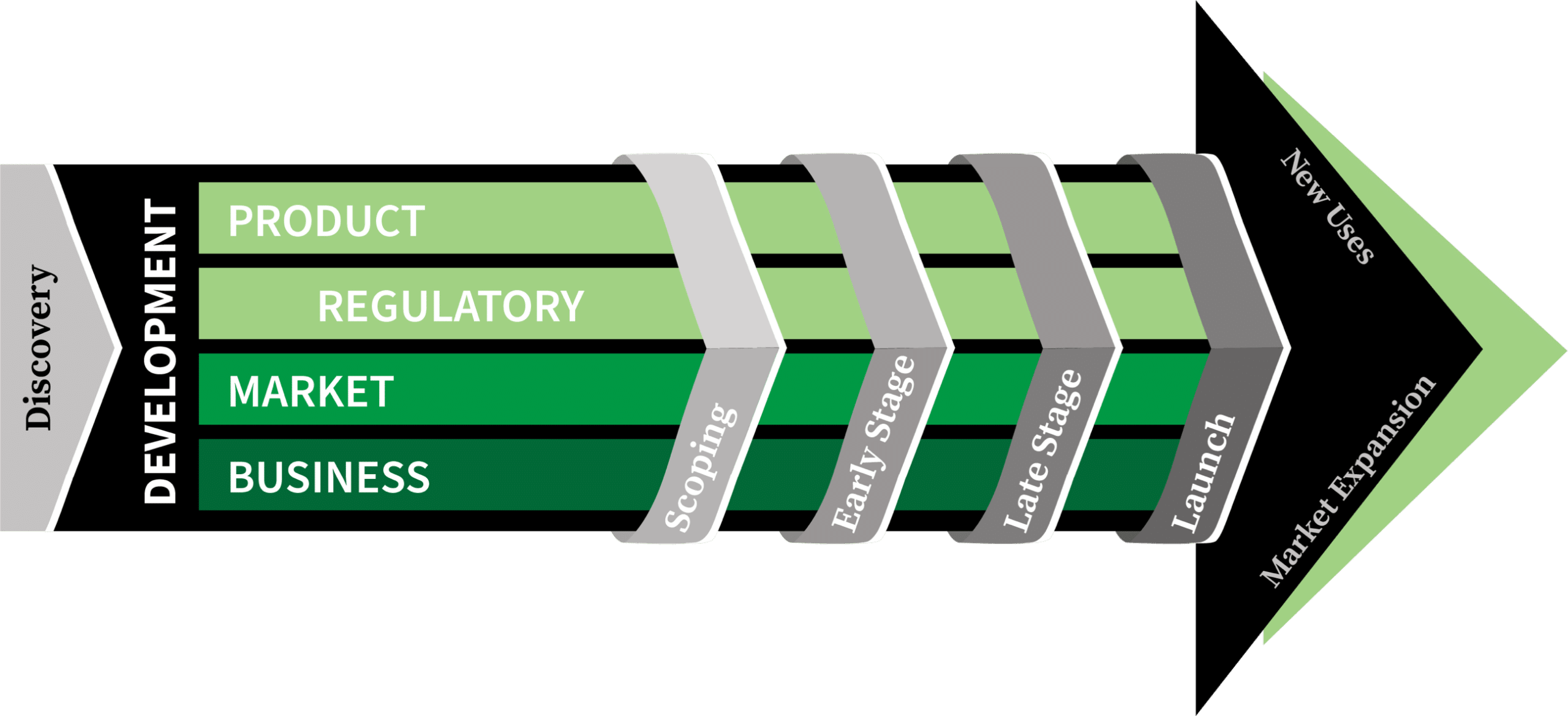
Stage 1: Concept Scoping for Validation
The movement from pure research into the early development phase begins with proving the product concept. The primary objectives at this stage are to validate meaningful benefits and define the scope of the opportunity. Controlled environment trials — typically in a greenhouse or growth chamber — help narrow key variables and establish a foundational understanding of how the product performs.
This critical first stage also sets the business case in motion. Intellectual property positioning, regulatory pathway identification, and freedom-to-operate assessments should all be completed here, alongside the scientific work. Commercialization timelines, which are often driven by registration requirements and crop seasonality, must be established early so that subsequent development phases can be planned and resourced accordingly.
Stage 2: Early Development
Early development moves the product concept out of controlled environments and into small-plot field trials. The goal is to generate performance facts: which variants, formulations, application rates, and timing windows deliver the most consistent and repeatable results. For biologicals and new chemistry alike, this stage tests the robustness of the product concept against real-world environmental variability.
At this stage, trials are limited in scale — a handful of locations and several treatment combinations — but the data generated is critical. This phase also finalizes regulatory strategy, pathways, and requirements and refines the safety profile while beginning to prioritize production options and target markets. Every decision made here narrows the path forward and reduces costly uncertainty in later stages.
Stage 3: Late Development
With clarity on how to deliver the product, development advances to large-scale small-plot trials conducted across multiple locations and multiple growing seasons. The robustness of this data directly determines how confidently the product can be positioned in the market. More environments and more replications mean more reliable conclusions about where, when, and how the new technology delivers its greatest value.
Reliable research partners are essential at this stage. The accuracy and credibility of the data generated in late development will be scrutinized by regulators, retail channel partners, and sophisticated growers. Cutting corners here creates vulnerabilities that emerge at the worst possible time — after launch.
Having a clear understanding of how to use the new technology is not enough to make it successful in the marketplace.
Late development builds the evidence base needed to demonstrate that the technology has consistent value across diverse conditions — not just in an ideal setting, but in the real environments where growers will actually use it.
Stage 4: Launch & Large-Scale On-Farm Trials
Thorough and credible small-plot data must be confirmed and expanded through large-scale, on-farm trials that demonstrate local relevance. This is the stage where the technology meets the audience that ultimately determines its success: growers.
Growers trust other growers. Conclusive data generated on farms in their region, on their crops, by their peers carries more persuasive weight than any other form of evidence. Large-scale trials also bring local retailers, dealers, and agronomists into the product’s story — people who serve as trusted advisors to the farming community and whose confidence in a new product directly influences adoption.
This phase is also where the go-to-market strategy comes to life. Technology transfer plans, value messaging, return-on-investment frameworks, and key opinion leader engagement must all come together around a clear, concise, and scientifically credible product narrative.
Turning Data into Messaging
Aggregating knowledge across every development stage is what allows technical performance data to be translated into messaging that the sales channel and their growers can trust. Key performance metrics, use-condition boundaries, and documented return on investment transform a promising product concept into a compelling and defensible market story.
Identifying key opinion leaders in the farming community — and building their understanding and advocacy early — is as strategically important as the scientific development itself. The launch phase is not the time to start those conversations.
All the research conducted won’t be effective unless you identify your customer, understand their needs, and recognize how to reach them.
Managing Complexity Through Discipline and Flexibility
Optimizing the product development process from discovery through launch requires managing many variables simultaneously. Much like farming itself, the complexity of development is compounded by uncontrollable factors — most significantly, weather and environmental variability across years and geographies.
These challenges demand both flexibility and resilience. Plans must adapt without losing their scientific integrity. But for organizations that commit to the discipline of a structured stage-gate process, the rewards consistently outweigh the risks. Products reach the market better understood, better positioned, and better supported by the data that growers and channel partners need to act with confidence.
Then growth through new uses or market expansion start the process again.
Partner with AgriThority® for Your Development Journey
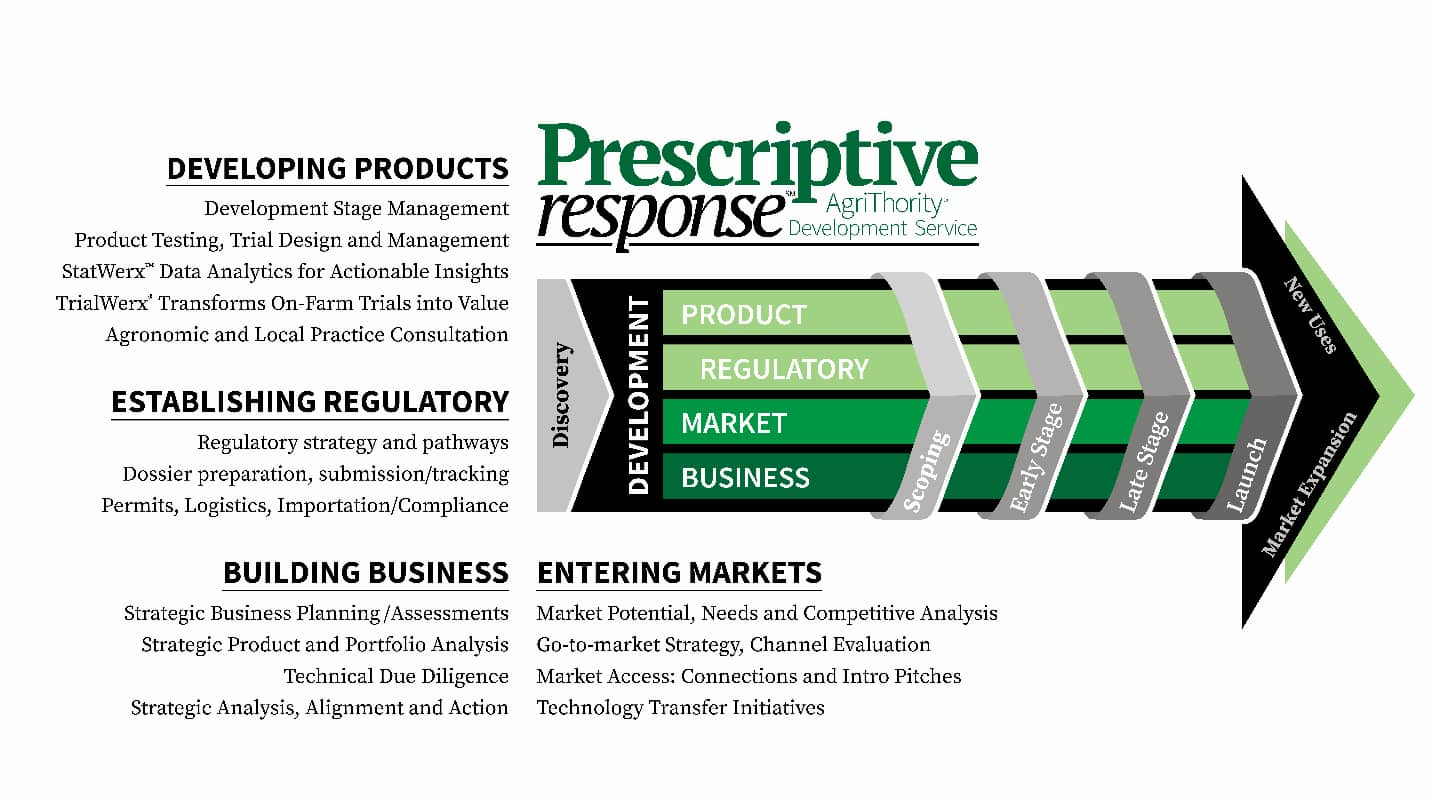
The AgriThority® Prescriptive Response™ Development service gives innovators access to consistent, disciplined data generated by experienced product development experts. When your research is ready for development, AgriThority brings scientific product, business, and market development, and regulatory expertise to every stage of the process.
As an independent global science resource, AgriThority focuses on exploring potential, expanding market access, and evolving production agriculture for greater food security and sustainability.
To learn more about Prescriptive Response™ development services, reach out today.